
The DC connector carries charging current from the charger to the battery. Anderson housing colour controls mechanical keying; the battery nameplate and approved charging configuration establish electrical compatibility.
Same SB size does not mean the connectors will fit
Match the SB family, housing size and keyed colour. Two SB350 housings do not necessarily connect just because both are SB350. Standard colour keys separate the connections: match red with red, blue with blue and grey with grey within the same SB series. A red SB350 does not mate with a blue SB350. Never force different keys together.
Start with that matching-colour rule. A few manufacturer-documented exceptions are listed separately below; they do not make different colours generally interchangeable.
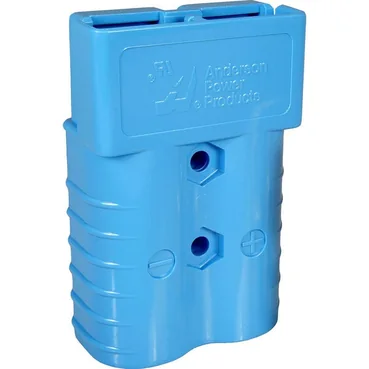
Blue SB350 keyed housing. Match with blue in the same SB series.
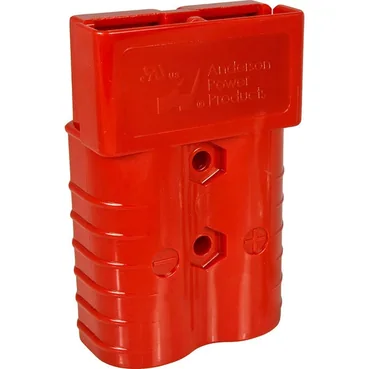
Red SB350 keyed housing. Match with red in the same SB series.
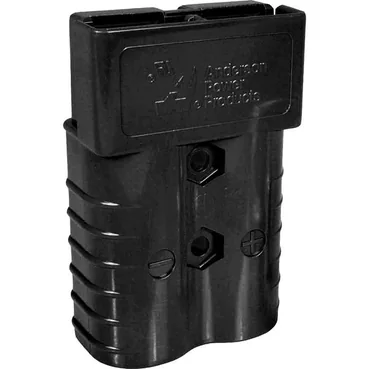
Black SB350 housing. See the documented exception below.
Actual Anderson Power housing photographs; contacts and cables are not fitted. Select a photograph for a larger view.
| Housing pair | Physical connection |
|---|---|
| Blue + red | No — different keys |
| Blue + blue | Yes — matching key |
| Red + red | Yes — matching key |
| Grey + grey | Yes — matching key |
Documented exceptions: check the exact series
- SB350 black and blue share a key and can mate.
- SB175 black keyless can mate with the other SB175 housing colours.
These exceptions establish mechanical fit only. Confirm the exact housing variant and manufacturer’s keying before using an exception. It does not establish battery voltage, polarity or a suitable charging profile.
Identify the SB housing series
SB50, SB175 and SB350 are different housing sizes. Matching colour across different series does not make the housings interchangeable. The series name alone also does not establish the assembled connector’s current rating; contacts and cable size determine the applicable rating.
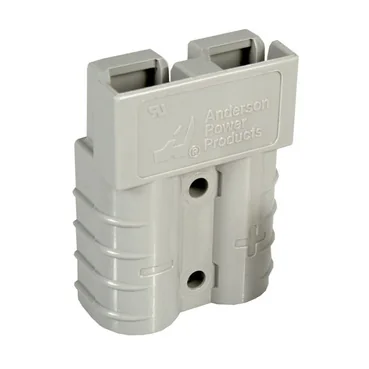
Two-pole SB50 housing. A different size from SB175 and SB350.
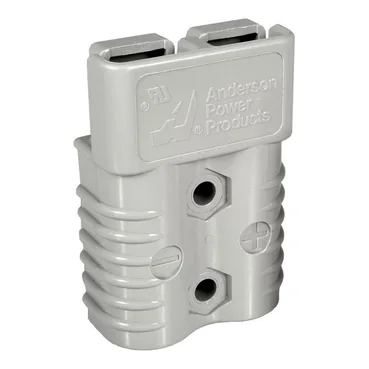
Two-pole SB175 housing. A different size from SB50 and SB350.
Photographs identify the housing series and are not displayed to a common physical scale. Product photographs: Anderson Power / IDEAL Industries.
Anderson SBE: check the auxiliary connections too
SBE is a separate Anderson connector family, with SBE80, SBE160 and SBE320 sizes. It has two main power connections and optional auxiliary contacts for control, interlock or communication. Match the family, size, colour/key and fitted auxiliary connections.
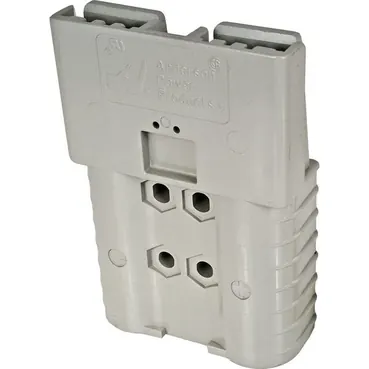
Housing example, shown without fitted contacts or cables.
An auxiliary position does not prove CAN or a particular battery communication system is fitted. Confirm the actual contacts, wiring and charger/battery requirements. Do not substitute SB or SBX by appearance: Anderson specifies that SBE320 and SBX350 do not mate, even with the same voltage colour code.
REMA DIN: match the coding and fitted options
REMA DIN connectors use a mating plug and battery socket, with familiar DIN80, DIN160 and DIN320 sizes. Check the size, voltage coding and battery-type coding rather than relying on the housing colour. The configured coding pins distinguish battery types such as wet, dry and lithium-ion.
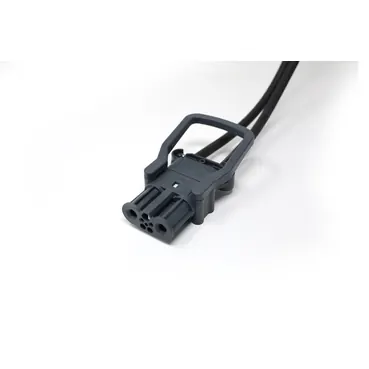
Assembled battery-side socket example with handle and cable.
Pilot contacts, auxiliary contacts and air connections for electrolyte circulation are optional. Match the fitted options and their wiring on both sides. Confirm the intended mating connector with the manufacturer; appearance alone does not establish cross-brand compatibility. REMA also makes SR/SRE flat-contact connectors: the DIN guidance here does not describe every REMA family.
The connector rating is not the charging current. The charger controls charging current; the assembled connector, contacts and cable must suit that current and the operating conditions.
Colour is a convention, not a voltage measurement
Connector colours have historically been used to separate battery voltage groups. A site or company may use its own documented convention. The housing does not sense voltage, and its colour does not prove how the connected battery is wired.
Use the battery nameplate for nominal voltage and the site’s documented convention for identification. Matching housings establish mechanical fit; they do not establish the correct battery chemistry, charging profile, polarity, cable or contact rating.
Stanbury multi-voltage charging
Compatible Stanbury multi-voltage chargers charge different approved battery voltages with the correct setup and charging profiles. These chargers provide wrong-voltage protection.
That protection is limited to voltage. It does not cover wrong chemistry, charging profile or polarity. Select a model supporting the battery voltage and use the battery-approved profile and current limits, including any required lithium BMS communication.
Read the battery chemistry guide or compare charger models. For a mixed fleet, discuss a configured charging system with our team.
DC connection questions
Will any Anderson SB350 connect to another SB350?
No. The series and size alone are not enough: standard SB housings must also match the keyed colour. For example, SB350 red mates with red and blue with blue; red does not mate with blue. Manufacturer-documented exceptions are listed separately. Check the colour-key rule.
Does Anderson connector colour tell me the battery voltage?
Colour may indicate a site’s voltage convention, but it does not prove the actual battery voltage. Housing colours provide mechanical keying; companies may use their own voltage conventions. Read the battery voltage from its nameplate. Understand colour and voltage.
Can a Stanbury multi-voltage charger charge different battery voltages?
Yes. Compatible Stanbury multi-voltage chargers support different approved battery voltages with the correct setup and charging profiles, and provide wrong-voltage protection. That protection is limited to voltage; it does not cover wrong chemistry, charging profile or polarity. Read the multi-voltage guidance.
Manufacturer references
Anderson Power: SB350 blue housing and data sheet documents the blue/black shared key. SB350 red housing uses different keying. See the Anderson SB overview, SB175 black keyless housing, Anderson SBE family, SBE320 housing details and REMA connector families and DIN options.