
The charger’s AC connection must match the supply voltage, phase and available current. Plug amps describe the AC connection; they are different from the DC charging amps delivered to the battery.
Single-phase and three-phase plugs
Single-phase plugs have active, neutral and earth contacts. Three-phase four-pin plugs have three phases and earth; five-pin plugs add neutral. Pin count is not phase count: a three-pin household-style plug is single-phase.
Single-phase examples
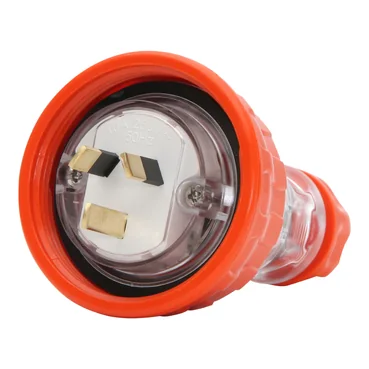
Industrial three-flat-pin plug. Active, neutral and earth.
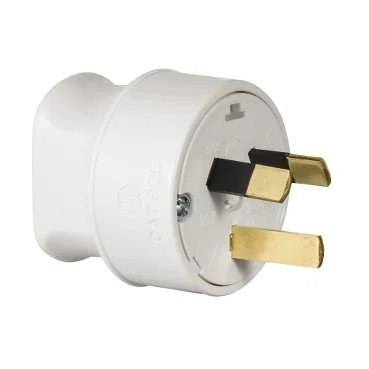
Three flat pins: active, neutral and earth. Manufacturer product photograph.
Three-phase examples
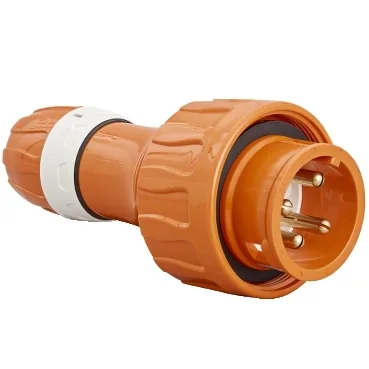
Australian 56 Series: three phases and earth. Pin face visible.
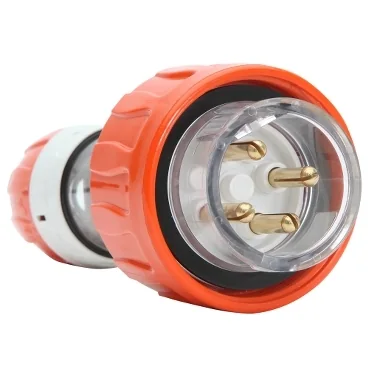
Three phases and earth. Rated 500 V; this rating is not a measurement of site voltage.
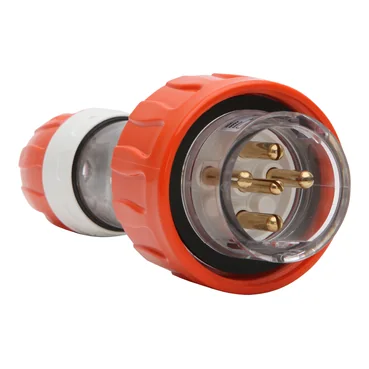
Three phases, neutral and earth. The extra centre pin is neutral.
Product photographs: PDL and Clipsal / Schneider Electric. Current rating and pin count are labelled for each product. Select a photograph for a larger view.
Which 10 A and 20 A plugs fit?
A standard Australian 56 Series 10 A plug fits a corresponding 20 A socket. A 20 A plug does not fit a 10 A socket. Four-pin plugs can use five-pin sockets; five-pin plugs cannot use four-pin sockets.
| Plug | 4-pin 10 A socket | 4-pin 20 A socket | 5-pin 10 A socket | 5-pin 20 A socket |
|---|---|---|---|---|
| 4-pin 10 A | Yes | Yes | Yes | Yes |
| 4-pin 20 A | No | Yes | No | Yes |
| 5-pin 10 A | No | No | Yes | Yes |
| 5-pin 20 A | No | No | No | Yes |
The 10 A connector has a slot at the bottom of its keying arrangement; the 20 A version has a flat section that prevents entry into a 10 A socket. A four-pin plug leaves the neutral contact unused in a five-pin socket.
This table covers standard Australian 56 Series 10 A and 20 A round-pin connections. It does not cover special-key 16 A variants, 32 A and larger connectors, or CEE connectors.
Match plug rating and site power to the charger
Stanbury configures the AC plug to customer requirements. The fitted plug can have a higher current rating than the charger requires, but it must never be rated below the charger’s required AC input current. For example, a charger requiring 10 A AC input can have a suitable 20 A plug; fitting that plug does not make it a 20 A charger.
Compare the charger’s AC input amps with the plug rating. DC output amps and output kW alone do not establish the required plug. The supply must also provide the correct voltage and phase, with suitable circuit capacity and protection. A larger plug does not upgrade that circuit.
Limited supply: smaller charger or infrastructure upgrade?
An appropriately smaller charger may suit the existing supply when a longer charging window is available. Plan its charge time against the battery’s approved profile and the time the vehicle is parked. For multi-shift work with a short turnaround, upgrading supply infrastructure may be necessary to support a larger charger.
Use the charger selector to compare outputs and available input supply, then compare charging methods. Our team can specify the charger and fitted plug; a qualified electrician assesses circuit capacity and installation.
AC connection questions
Will a 10 A three-phase plug fit a 20 A socket?
Yes, for standard Australian 56 Series 10 A and 20 A round-pin connectors. A 10 A four-pin plug fits four-pin or five-pin 20 A sockets. A 10 A five-pin plug fits a five-pin 20 A socket. A 20 A plug does not fit a 10 A socket. See the complete fit table.
Will a four-pin plug fit a five-pin socket?
Yes, within the standard Australian 56 Series 10 A/20 A combinations shown in the table. Four pins provide three phases and earth. The fifth socket contact is neutral and is unused by the four-pin plug. A five-pin plug does not fit a four-pin socket. Compare all four combinations.
Can my charger have a plug rated higher than its input current?
Yes. Stanbury configures AC plugs to customer requirements. The plug current rating can be higher than the charger’s required AC input current, but never lower. Compare AC input amps with plug amps, not the charger’s DC output amps. A larger plug does not increase the capacity of the supply circuit. Match the charger to site power.
What if my site cannot supply the charger I want?
Choose an appropriately smaller charger if the available charging window allows a longer charge. A multi-shift fleet needing a fast turnaround may need a supply infrastructure upgrade to support a larger charger. Compare the supply and charging-window options.
Technical references
Clipsal Industrial Switchgear catalogue (PDF): connector configuration chart, printed page 161, and 56 Series plug tables. Floorex: three-phase plugs and sockets explained: 10 A/20 A keying and four-pin/five-pin mating.
Photographed products: PDL 15 A single-phase plug and PDL 56 Series.