
Find the right charger
for your operation.
Enter your battery and site details to compare chargers, review charging estimates and create your own cut sheet.
Start with your battery
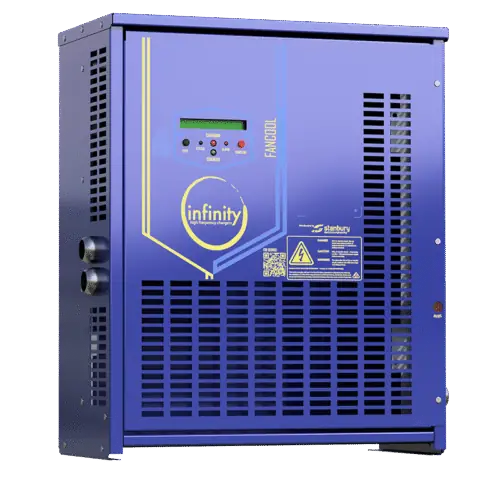
Compact, wall-mountable multi-voltage charging in 48 V and 80 V ranges. Profiles are set for your batteries and daily charging routine.
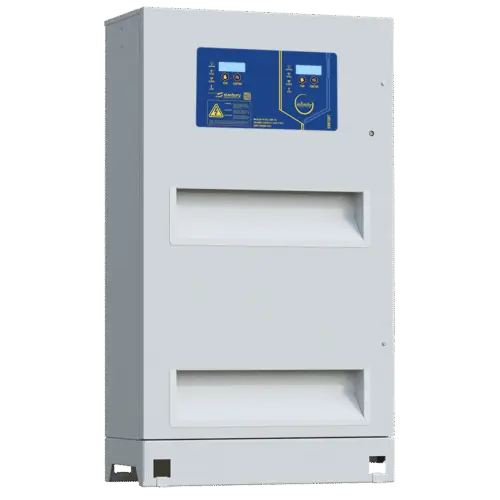
Higher-output, multi-voltage three-phase charging across 24–80 V. Battery-specific profiles suit larger batteries, demanding shifts and approved fast charging.
NEMA 3R / IP54 outdoor enclosure options for airport GSE and port fleets. Plan charging for the apron, terminal and yard; confirm the specified enclosure and site conditions.
Range images. Your details below determine the suggested model.
Start with your battery.
Closest charger options
Loading current charger specifications…
Fast, opportunity or standard charging?
Do you supply fast chargers?
Yes. Any charger in our range can be used for fast charging when it is correctly sized for the battery and configured with the correct approved profile. The same charger can serve different charging methods, depending on the battery it is paired with.
For example, 50 A into a 100 Ah battery is a 50% charge rate. The same 50 A into a 500 Ah battery is a 10% charge rate. The battery must accept the selected current, and the site must provide the required power.
Can your chargers do opportunity charging?
Yes, with the right sizing and battery profile. Opportunity charging puts energy back during normal breaks or shift changes, so the charger needs to return enough energy during those available stops.
For example, 100 A for a 30-minute break can return up to 50 Ah before losses or current tapering. For a 500 Ah battery, that is up to 10% of capacity. We check that the battery permits the profile and that the available breaks can keep up with daily use.
What is standard charging?
Standard, or conventional, charging uses a planned charging period, often after a shift. The charger is sized to restore the battery during that downtime using its approved profile.
For example, the selector’s 15% starting rate gives 75 A for a 500 Ah battery. The actual charge time also depends on how discharged the battery is and the profile’s finishing stage. It is a planning starting point, not a promise of a full charge in a fixed time.