
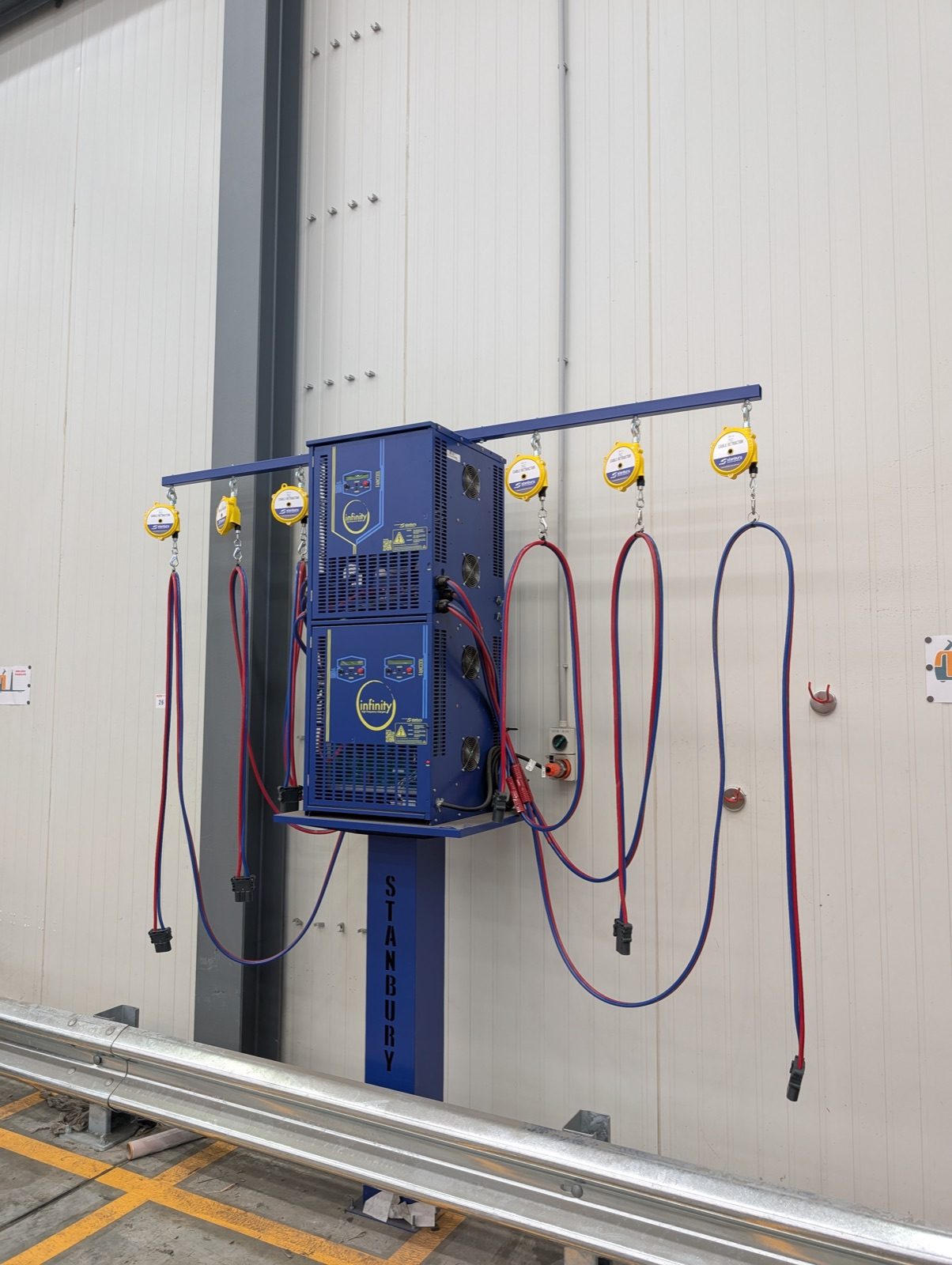
A charger can be correctly sized and still be frustrating to use. The surrounding bay determines whether connection is straightforward and whether cables stay clear of traffic.
Keep cables off the floor
Retractors and appropriate mounting can reduce run-over damage and keep connectors accessible. Specify cable travel and mounting height around actual parking positions. A retractor is not a substitute for safe operator procedures.
Replace a connector by specification
Match the connector family, size, keying, polarity and current rating. Colour or appearance alone does not establish compatibility. Confirm contacts and cable size before ordering a replacement.
Make the charger accessible
Wall brackets or stands can lift chargers clear of vehicle movement while keeping controls accessible. Installation must account for cabinet weight, fixing suitability, airflow and maintenance access.
Look at total electrical demand
One charger’s input current is only part of the picture. When multiple trucks finish a shift together, chargers may draw at the same time. Discuss multi-output arrangements or load management alongside the electrician’s assessment of supply capacity.
Work through a bay before placing the chargers
Start with a simple drawing showing the parked equipment, charger positions, pedestrian paths and vehicle routes. Include the battery or connector position on each vehicle. A neat row of chargers can still be difficult to use if cables need to cross a walkway or reach around another parked truck.
| Area | Record | Why it matters |
|---|---|---|
| Parking | Equipment dimensions and connection points | Sets cable reach and operator access |
| Supply | Phase, voltage, plug and available circuit capacity | Constrains the charger selection and simultaneous demand |
| Mounting | Wall or stand position, clearances and fixing arrangement | Allows safe installation and maintenance access |
| Environment | Rain, dust, salt, temperature and condensation | Informs enclosure and placement review |
| Operation | Return times, breaks and equipment needed next | Informs charger outputs and priorities |
Example: a mixed warehouse fleet
A bay serving 48 V forklifts and lower-voltage pallet trucks needs more than enough parking spaces. Record the voltage and chemistry for each battery group, connector markings and the times vehicles return. Compare each group against the model output tables, then agree the profiles and identification process. Do not assume equipment can share a charger simply because it uses the same parking bay.
If several vehicles finish a shift together, review combined AC demand. Multi-output cabinets can bring charging points together around one input, but they do not create additional supply capacity. RTPI monitoring and load-management options are a separate discussion about the site’s operating needs and compatible equipment.
Example: airport or port-yard equipment
Start with the parking and handover pattern. Check whether vehicles return to fixed bays or a shared equipment pool, which units are needed first, and how connectors will be stowed. Review impact protection, drainage and exposure with the installer. An outdoor cabinet’s protection rating is one part of that assessment, not a substitute for it.
Keep charger access and authorised service access in the layout. Industrial equipment should not need to be moved through a busy traffic route just to reach a control or connection. Servicing the charger itself belongs with an accredited service agent or a person authorised by Stanbury.
Common questions
Will a retractor suit every charging cable?
Confirm cable weight, required travel, mounting height and the intended cable path. Check the retractor and mounting specifications for the actual installation.
Can more outlets fix a charging bottleneck?
More outlets can improve access, but the battery charging requirements, combined demand and available charging time still determine whether the equipment can be ready when required.
What should the electrician review?
The proposed charger input requirements, available supply and circuit protection, plug configuration, installation conditions and simultaneous loads. The website shortlist is a planning aid; it is not an electrical installation design.
Next: explore multi-output configurations, review outdoor charging or see the RTPI demonstration.